
Business activity has fallen by a fourth of the pre-COVID levels due to lockdowns imposed by states to contain the spread of the second wave of COVID-19, Japanese brokerage Nomura said on Tuesday. However, it said the falling activity levels will have a muted economic impact and maintained its growth estimates for the year, saying the lockdowns present "downside risks". As of April 25, the Nomura India Business Resumption Index (NIBRI) registered its steepest weekly fall in over a year of 8.5 percentage points to 75.9, which is 24 percentage points below pre-pandemic normal, the brokerage said in a statement.

The Organization of Petroleum Exporting Countries (OPEC) in its latest monthly oil market report projected the world's third-biggest energy consumer to add 0.39 million barrels per day (bpd) of crude oil demand in 2022. India's oil demand rose from 4.51 million barrels per day in 2020 to 4.76 million bpd in 2021, recording a 5.61 per cent growth.

Days after keeping India's rating at lowest investment grade for 13th year in a row, the rating agency in a webinar said despite the contraction in GDP this year, the country continues to be an outperformer among the peer groups.

Fitch said COVID-19 is still in India and it is very likely that the government will have to spend a bit more on fiscal measures to support the economy.

The Asian Development Bank said on Thursday it raised its 2002 growth forecast for the region's economies to 5.6 per cent, but trimmed its estimate for next year to the same rate as an export boom would tail off.

India's economy grew 8.8 percent year-on-year in the June quarter, the strongest performance in more than two years, powered by robust manufacturing growth.

International Monetary Fund Chief Economist Gita Gopinath tells Indivjal Dhasmana high-frequency indicators for the third quarter of 2021 indicate momentum in economic recovery in India.
The economic think-tank National Council of Applied Economic Research on Thursday revised downward marginally India's economic growth to 6.62 per cent due to deceleration in farm output in 2004 even as fiscal deficit was slated to shrink to 4.52 per

Fitch Ratings director Thomas Rookmaaker said India's debt-to-GDP ratio is likely to rise to 76 per cent from 70 per cent currently due to wider fiscal deficit and low economic growth.
Credit rating agency ICRA on Tuesday lowered economic growth projection for the Indian economy to 6.3 per cent this fiscal from its earlier forecast of 6.5-6.7 per cent due to an expected fall in farm output. \n

The brokerage said that the reform measures announced by the government will help growth only over the medium term and are not expected to have any benefit in the near-term.
Standard & Poor's, which has threatened to downgrade the country's sovereign rating to junk, sees economic growth improving.
Standard & Poor's, which has threatened to downgrade the country's sovereign rating to junk, sees economic growth improving.

According to a new report by international management consulting firm Arthur D Little, the worst of COVID-19's impact will be felt by India's most vulnerable in terms of job loss, poverty increase and reduced per-capita income, which in turn will result in a steep decline in the Gross Domestic Product (GDP). "Given the continued rise of COVID-19 cases, we believe that a W-shaped recovery is the most likely scenario for India. This implies a GDP contraction of 10.8 per cent in FY 2020-21 and GDP growth of 0.8 per cent in FY 2021-22," the report said.

India's services sector activity expanded at the second-fastest pace in more than a decade during November, driven by sustained rise in new work and improvement in market conditions, a monthly survey said on Friday. The seasonally adjusted India Services Business Activity Index was at 58.1 in November, fractionally down from 58.4 in October. The November figure points to the second-fastest rise in output since July 2011. For the fourth straight month, the services sector witnessed an expansion in output.

The rising pitch of road shows and long rallies with hectoring pitches seem to have exhausted and numbed the audiences, rather than motivating them to vote for the party, observes Shreekant Sambrani.

Starting with the third quarter of financial year 2020-21 (Q3FY21), we have seen "unlock" trades at various times. Whenever lockdowns have been eased, traders have taken long positions in consumer-facing businesses. Let's look at the logic. Since March 2020, sectors like retail, personal vehicles, hospitality, aviation, fast-moving consumer goods (FMCG), multiplexes, etc., have been under severe pressure. As a result, there's been a low base effect. Every company in these spaces has suffered top line contraction. Many suffered losses, especially in the first half of FY21.
Former Union Finance Minister Manmohan Singh said the GDP growth rate might not exceed 7-7.25 per cent this year.

With the world's worst outbreak of COVID pandemic stalling a nascent economic recovery, the government has begun assessing the impact of the second wave of infections on different sectors and may look at providing support at an appropriate time to segments requiring fiscal help. Some of the economic indicators, including the Goods and Services Tax (GST) collections, still provide confidence and incoming data will throw some more light on the state of the economy, sources said. Services sectors like hospitality, tourism and aviation which had just started recovering were hit hard by the second wave of COVID, the sources said, adding these segments might need some support on an urgent basis from the government.

Pakistan was "drowning" in debt and it was the new government's job to "sail this ship ashore," Prime Minister Shehbaz Sharif said on Wednesday.

India's GDP estimates for 2020-21 show that the economy is expected to perform much better than earlier projections by different agencies, indicating a sustained V-shape post-lockdown recovery, experts said. The first Advance Estimates (AE) by the National Statistics Office (NSO) has projected a contraction of 7.7 per cent in the real GDP during 2020-21. This was better than the projections by certain international agencies like the IMF and World Bank.
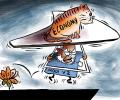
The country's new economic roadmap highlights the importance of creating a virtuous cycle of investment, savings and exports in order to sustain rapid economic growth over the next five years.

Concerned over elevated inflation, Reserve Bank of India on Friday decided to leave the benchmark interest rate unchanged at 4 per cent but maintained an accommodative stance, implying more rate cuts in the future if need arises to support the economy hit by the Covid-19 pandemic.

A below-normal monsoon is likely to drag down the food output with India's agricultural GDP growth likely to slump to 0.8 pc in the current fiscal, says a report by the Japanese brokerage firm Nomura.
The economic costs now beginning to show up in the hard numbers are far worse than initial expectations.

E-way bill generation, which is related to paying Goods and Services Tax (GST) and a key high-frequency indicator of economic activity, may have fallen to a five-month low in April as more cities experience lockdowns due to a surge in Covid-19 cases. In April e-way bill generation may decline to 55-58 million, which is the lowest since at least November. On the higher side, it is a 17 per cent decline over March.

Reserve Bank of India (RBI) on Friday kept the benchmark interest rate unchanged at 4 per cent and decided to continue with its accommodative stance despite rising inflation. This is the 11th time in a row that the Monetary Policy Committee (MPC) headed by RBI Governor Shaktikanta Das has maintained the status quo. RBI had last revised its policy repo rate or the short-term lending rate on May 22, 2020 in an off-policy cycle to perk up demand by cutting the interest rate to a historic low.

The IMF lowered India's economic growth estimate for the current fiscal to 4.8 per cent and listed the country's much lower-than-expected GDP numbers as the single biggest drag on its global growth forecast for two years.

In India, economic activity slowed substantially in 2019, with the deceleration most pronounced in the manufacturing and agriculture sectors, whereas government-related services sub-sectors received significant support from public spending, the Bank said.
HSBC on Thursday said the Indian economy, which is projected to grow at 5.7 per cent this fiscal, is likely to grow at a faster pace next fiscal at 6.9 per centfollowing the recent spate of policy reforms.

'The Indian economy and the Indian financial sector today remain resilient and much better placed.'

Tata Motors was the biggest loser in the Sensex pack, tumbling 2.47 per cent, followed by Reliance Industries (2.44 per cent), Maruti (1.84 per cent), SBI (1.76 per cent) and Bajaj Finance (1.23 per cent).

'India is nowhere near the peak of the infection given its large population of 1.3 billion'

TCS was the biggest loser in the Sensex pack, sliding 3.17 per cent, followed by HCL Tech, Yes Bank, IndusInd Bank, RIL, ICICI Bank, Infosys, Tata Steel, Kotak Bank and L&T, down up to 2.34 per cent.

Bank of America (BofA) Securities expects India to be the third-largest economy in the world by 2031. The economic rise could become a reality by 2028, but the Covid pandemic delayed the pace, BofA Securities economists Indranil Sen Gupta and Aastha Gudwani wrote in a report.

'Vaccination is very important for an economy to start functioning properly.'
Even with the possible expenditure roll-overs and off-budget financing, the fiscal deficit target will not be met. The FRBM Act, after its amendment in 2018, allows a fiscal deficit slippage of not more than 0.5 per cent for any given year, provided there are justifications. These justifications include war, national security, severe collapse in the agriculture sector, a major natural calamity, big structural economic reforms, or the decline in real output growth of a quarter by at least 3 percentage points below its average of the previous four quarters.
The wholesale price index inflation is projected at 6.4 per cent for 2017-18.

Lower crude prices and dip in gold demand will push the CAD down.
